Catania’s history is a millennia-long web of dominations (Greeks, Romans, Byzantines, Arabs, Normans, Spanish) and rebirths, marked by the proximity of Mount Etna and by devastating natural events such as the earthquakes of 1169 and 1693, after which the city was rebuilt in the Sicilian Baroque style that still defines its historic center, a UNESCO World Heritage Site. Founded in 729 BC by the Greeks of Naxos, it rose to prominence under the Romans, becoming the capital of the Kingdom of Sicily under the Aragonese, and home to the first Sicilian university in 1434. After natural disasters, it rose gloriously to become a center of culture and commerce.
What to See in Catania
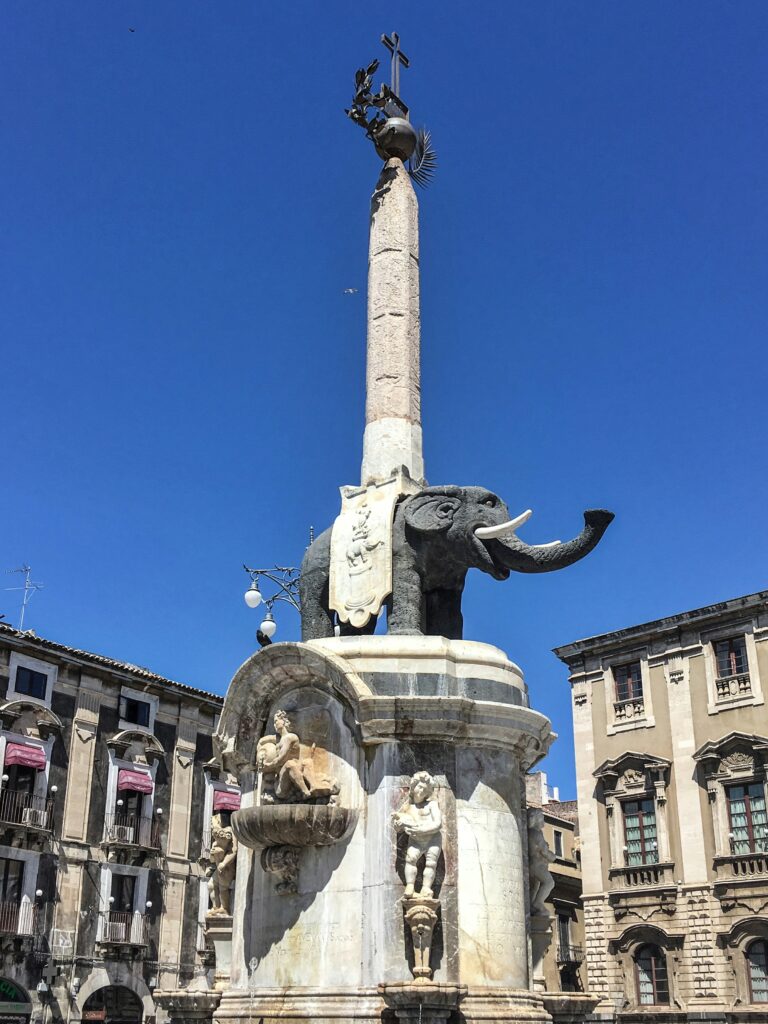
Piazza Duomo
Piazza Duomo with the beautiful elephant statue made of lava stone located in the center of the square.
The Benedictine Monastery of San Nicolò l’Arena
The Benedictine Monastery of San Nicolò l’Arena in Catania is one of the largest monastic complexes in Europe and a UNESCO site of great historical and cultural interest. It currently houses the Department of Humanities at the University of Catania.
Catania’s Fish Market – “A Piscaria”
Catania’s Fish Market, known locally as “A Piscaria,” is a historic and vibrant place located near Piazza del Duomo, beneath the ancient walls of Palazzo dei Chierici. It’s renowned for its authenticity, the loud calls of its vendors, and its traditional Sicilian atmosphere.
You can visit the market to buy fresh fish, fruit, and vegetables, or to enjoy excellent seafood street food in the surrounding area.
Via Crociferi
Via Crociferi in Catania is a monumental 18th-century Baroque street, considered one of the most beautiful in Italy. It is famous for its extraordinary concentration of 18th-century churches and palaces, such as the Church of San Benedetto, the Jesuit College, and Villa Cerami, a unique route in the heart of the historic center.
The street, a pedestrianized stretch in the center, connects Piazza San Francesco d’Assisi to the Arch of San Benedetto, offering a complete immersion in Sicilian Baroque, with lava stone buildings and wrought-iron balconies.
Ursino Castle
Catania’s Ursino Castle was built by Frederick II of Swabia in the 13th century. The castle gained prominence during the Sicilian Vespers, as the seat of parliament and, later, the residence of the Aragonese kings of Sicily, including Frederick III. Today, it houses the Civic Museum of Catania, consisting primarily of the Biscari and Benedictine collections.
The Greek Theater
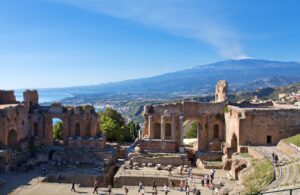
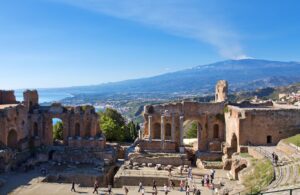
The Greek Theater, built largely of lava stone, could accommodate up to 7,000 spectators and still features intact cavea, orchestra, and parts of the stage. It is flanked by a smaller theater, the Odeon.
A unique aspect of the site is how it is nestled between modern buildings, a remarkable example of the city’s overlapping historical layers. The area also includes a small museum with artifacts from the excavations, illustrating the monument’s various historical periods. The waters of the Amenano River still surface in part of the orchestra.